
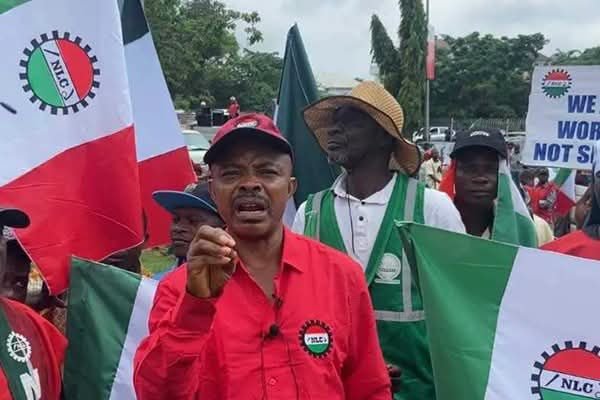
The National President of the Nigeria Labour Congress (NLC), Comrade Joe Ajaero, has argued that the union has the power to negotiate alone on labour matters based on the principle of the most representative workers’ organisation of the International Labour Organization (ILO).
Ajaero spoke while appearing as a guest on Channels Television’s The Morning Brief on Monday, as monitored by CoreTV News. According to him, the Trade Union Congress (TUC) can only negotiate alongside the NLC but not alone.
“TUC can negotiate along with NLC, but NLC can negotiate alone based on the principle of the most representative workers’ organisation of the ILO,” the NLC president noted.
This comes after both labour bodies disagreed over the ₦70,000 transport intervention approved by the Federal Government for workers across all levels for six months.
Ajaero stated that the TUC has no power to sit at the negotiating table alone with the labour authorities. The labour leader argued that the Trade Union Congress is required to present its proposals to the NLC when engaging with the ILO.
“TUC sent their negotiation alone ahead of the ILO conference, but they returned it, and I had to intervene. They have to send their list here for me to forward it; that is the position of the ILO. NLC determines how TUC participates,” he said, adding that the TUC does not submit its proposals to the TUC. “It is the other way round.”
Ajaero stated that the Ministry of Labour and other labour authorities would not engage with the TUC when it acts alone on workers’ welfare negotiations.
“TUC can’t negotiate alone; if they are saying so and it is implied, it does not happen. I don’t think the Ministry of Labour or the labour authorities will allow that to happen.”
Responding to Festus Usifo’s position that the TUC has over 300,000 members in the federal civil service, Ajaero said the 2005 Trade Union Amendment Act made membership of trade unions voluntary.
“ It is the worker that determines the union he belongs to; the Act makes membership voluntary.”
He further cited Section 40 of the 1999 Constitution of the Federal Republic of Nigeria, as amended, which guarantees every Nigerian the right to belong to any trade union, political or religious association of their choice.

He argued that Usifo’s claim of having a significant number of workers in his union did not add up, given that only one TUC-affiliated union belongs to the Joint National Public Service Negotiating Council, which comprises eight unions, seven of which are affiliated with the NLC.
He further argued that the TUC-affiliated union, which is a member of the joint body, had subjected its powers to the joint body.
Ajaero maintained that the Nigeria Labour Congress engaged with the Federal Government to secure the ₦70,000 transport intervention.
“We gave the government an ultimatum; we were supposed to start an action. The government asked for four days to meet with us, and we met. They resumed sitting after four days. After the meeting, the ₦70,000 allowance came up.”
He asserted that minimum wage demands could not be presented when the government had not set up a negotiation committee, stating that any wage increase required wider consultations among labour leaders, government officials and employers.

